
sardiniatourism
Hospitality
Photogallery
Alghero
algheroAlghero is located in north-western Sardinia, in the province of Sassari. Counting about 40,000 inhabitants, Alghero can be considered as a Catalan city as almost 40% of its population speaks a Catalan dialect. The name “Alghero” stems from the abundance of seaweed (alghe) in its surrounding waters. It used to be known as Algarium in the Middle Ages and Al Alguer and Barcelloneta under Spanish rule.
Alghero was founded around the X Century when the Genoese, supported by the Pisans, fought the Arabs off and obtained land grants from the Judges of Logudoro, one of the groups of judges that governed Sardinia during the Middle Ages. The Genoese House of Doria conquered the city at the beginning of the XII Century and governed it until 1353 when the Catalan fleet defeated Genoa's ships near Porto Conte on the outskirts of Alghero. The population of Alghero rose against the garrison's commanding officer, killing him. The Spanish responded by sending 12,000 men and 100 galleys to hold back the revolt. A treaty was signed and the original inhabitants were expelled from their homes and allowed the town to be settled by Catalan families. When Charles V decided to use the city as an operations base against Saracen pirates, he visited Alghero and was so warmly received by its people that he proclaimed them “todos caballeros”, a mark of distinction still held in regard today by the Algherese. In 1713, when Alghero came under Austrian rule with the Treaty of Utrecht, Spain tried once again to conquer the city but was compelled by the Treaty of London to yield Sardinia to the House of Savoy. Once again, Alghero was not greatly disturbed by foreign influences until it suffered bombings during World War II. Fearing an invasion by the Allied forces, the Sardinians built bunkers in strategic locations around the city that still stand today as grim reminders of Alghero's more troubled times.

Alghero’s old city is surrounded by thick fortress walls, interrupted only by solemn towers. The old city's stone streets, narrow and bordered by shops, are dotted with randomly spaced and seemingly unplanned tiny piazzas (squares). The multicoloured dome of the |link|foto|555|church of San Michele| and the church of St. Francis' pointed Aragonese tower dominate the city. Alghero’s monuments represent the gothic-Catalan style.
A tour of the city should begin at Porta a Terra Square, on the eastern side of the old town that extends into the vast green area of the public gardens where Giuseppe Manno's statue, a historian from Alghero, can be seen. The monument was made in 1894 by Pietro Canonica.
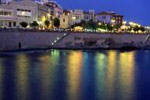
San Francesco street includes the town's principal meeting place "Piazza Sulis", overlooking the sea and the impressive Espero Reial and Sulis towers.
Along the seaside and at the end of Colombo Way, is the recently restored San Giacomo Tower (San Jaume) next to the church of Our Lady of Carmelo from the XVI Century.
The promenade Marco Polo extends past the bastion of San Giacomo, characteristic for its narrow openings from which canons were once fired. The seaside opens onto the beautiful panorama of the Algherese roads and the promontory that separates the city from the Porto Conte inlet. Its headland is called Capo Caccia.
The small tower of Polveriera (or St. Barbara) is past the bastion, where the coast reaches the north-west end of the promontory and the old city is situated. The coast then turns east, nearing the upper part of the tower of St. Elmo. From here it's possible to see the pier, the port and the landscape far to the north including the long beach of San Giovanni, the small island of Maddalena, Calic marsh and the colourful mountains of Nurra.
Continuing along Magellano Way and the seaside, you will find the narrow wall passage with a series of arches that seem to close in around the city's antique dock.
Continuing on, between the coastline and curved walls, you'll get to the summit in front of the doors that once opened to the sea. This is one of the historic accesses to the fortified city. Nearby there are the impressive ruins of the Maddalena Fort where Giuseppe Garibaldi disembarked the 14th of August 1855 as captain of the cargo ship "Il Lombardo".
Entering the old city, the visit starts in Piazza Civica (historically "placa de la Dressana"). Here medieval arches lean against the walls of Count Serra di Sant'Elia's Palace, the House of Savoy's Master of Ceremonies and the deconsecrated church of Rosario from the XVII Century.
We cross the Duomo's small square, where we can see the front of the Cathedral, dedicated to St. Mary, with a richly decorated apse and octagonal bell-tower inspired by the best examples of the late Catalan-Gothic period and constructed between 1562 and 1579.
At Principe Umberto street n.11, you will find the interesting "casa Doria" from the XVI Century with its renaissance-styled facade and gothic windows. Just beyond it is Curia Palace, the headquarters of the Episcopal archives unified with the capitulary ones of the St. Mary church. At the end of the street is the Mercy Church. Another important church is dedicated to St. Michael and is near Ginnasio Square.
Past the Carlo Alberto street intersection, you will come across one of the most interesting buildings of Catalan culture in Sardinia. The church complex, convent and St. Francis' cloister, was constructed in the first part of the 1300's and partially reconstructed at the end of the 1500's following its collapse in 1593, and finally restored in the XVIII Century. It was founded by the St. Francis convent monks who settled in Alghero prior to 1330 and who are still present today.
Surrounded by water on three sides, the "old city" of Alghero, centre of its traditions and customs, seems to be held captive again - not by the Spanish who once dominated the city for some 360 years, but by the very people who love the city so dearly.
There are many interesting events in Alghero that demonstrate this region's rich tradition. New Year's Eve is the most interesting one. The huge festival includes entertainment in the main square, fireworks, thousands of participants and lots of fun.
Another significant period is the Holy Week with its celebrations originating from the Catalan tradition dating back to the XVI Century.